
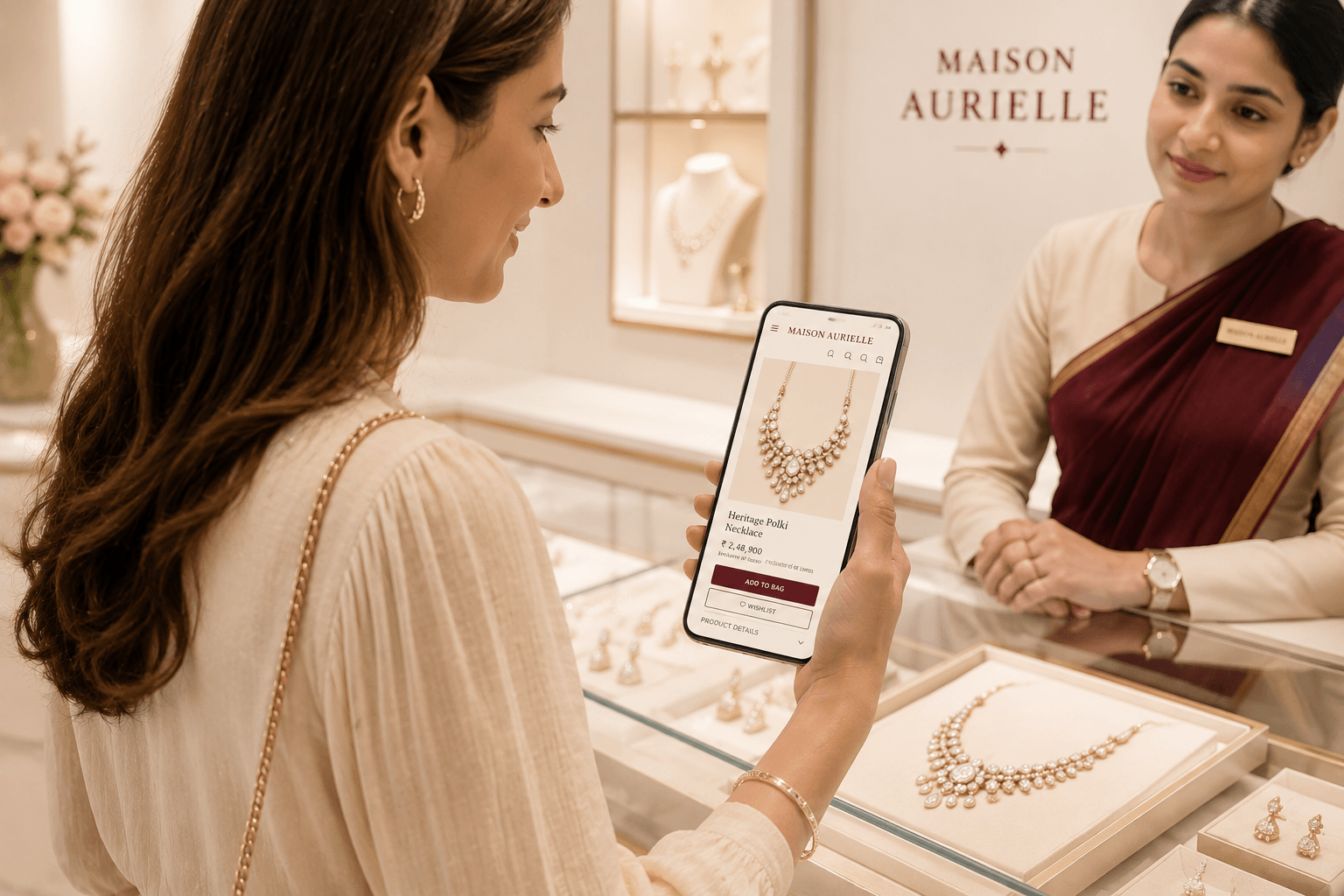
Here’s what’s actually true in 2026: the sale happens in-store, but the decision is increasingly made online, first. By the time a buyer walks into your showroom, they’ve usually already looked you up, compared you, and decided whether you’re worth the visit. If your website loses that moment, you don’t just lose an online sale. You lose the in-store one too, and you never find out it happened.
Your website isn’t your cash register. It’s your first impression.
If you think of your website as the place where online sales happen, and your sales happen offline, then of course the website feels secondary. But that’s the wrong job description. For most jewellers, the website’s real job isn’t to take the payment. It’s to win the customer before they decide where to spend.
The website is where a buyer forms their first impression of your brand, checks whether you’re credible, sees whether your pieces are the kind they want, and decides whether you’re worth walking into. That decision happens on screen, often before any human contact.
Your website isn’t competing to be your cash register. It’s competing to get the customer through your door at all.
Judge it by that job, and a weak website stops looking harmless and starts looking expensive.
What actually happens before a buyer walks in
A buyer sees a piece on Instagram, or has an occasion coming up. They search. They land on a few jewellers’ websites and compare. They look at the pieces, the pricing, the certification, whether the brand feels trustworthy and serious. They form an opinion, often in seconds. And then, only then, do they decide whose store is worth their time.
The sale closes at the counter. The decision was made online, before you knew it was happening.
Every step of that happens before the buyer contacts you. You’re being evaluated, ranked and shortlisted while you have no idea it’s happening. The showroom visit, the one you think of as the start of the sale, is actually near the end of a process that ran entirely without you in the room. So the question isn’t whether your customers use the internet to buy jewellery. It’s whether your website is winning the part of the decision that has already moved online, because that part decides who gets the visit.
Why “we sell in-store” is the trap
The belief that quietly holds jewellers back is this: “our sales happen at the counter, so the website doesn’t really matter.” It’s a trap because it’s half true. The sale does happen at the counter. But the decision increasingly doesn’t, and the belief blinds you to the losses, because they’re invisible.
The visits that happened
- Customers who walk in
- Footfall and counter sales
- The buyers who chose you
The visits that didn’t
- Buyers who researched you online
- Weren’t convinced by what they found
- Quietly chose a competitor
There’s no bounce report for your showroom. The lost visit leaves no trace. So the jeweller concludes the website isn’t costing them anything, when it may be costing them the most valuable thing of all: the buyers who never arrived. This is also why “cheap website for now” is such a false economy. A weak, broken or untrustworthy-looking site doesn’t just fail to make online sales. It actively loses in-store sales, by failing the buyer at the exact moment they were deciding whether to visit. (We’ve written separately on why the cheapest website is usually the most expensive, and it’s this hidden cost that’s the reason.)
The buyers you lose this way are your best ones
The buyers who research hardest before visiting are usually the serious, high-value ones. Someone buying a small everyday piece might walk in on impulse. Someone about to spend lakhs does their homework first, and does it online (all the more so with gold at record highs). So the customers you lose to a weak website are disproportionately your most valuable ones.
It’s sharper still for two groups. The next generation, who research everything digitally and often can’t find traditional jewellers online at all. And NRI buyers, who can only start online: they physically cannot walk into your store to form a first impression, so your website isn’t part of their decision, it is their decision. Lose the research moment, and you lose exactly the buyers worth the most.
What winning the research moment looks like
Winning it doesn’t necessarily mean building a full e-commerce operation. It means having an online presence that does its real job: convincing a researching buyer that you’re worth their trust and their visit.
That means showing your pieces well, so a buyer can see the quality. It means building trust visibly, with certification, hallmarking and clear pricing, so a careful buyer feels safe. It means answering the questions a buyer has before they’ll commit, and making it effortless to enquire or book a visit. And it means connecting that online interest to your store, so the buyer who decides online actually shows up in person, which is omnichannel, done simply and without the jargon.
Whether the right build for you leans toward enquiry or full e-commerce depends on how your buyers buy, and it’s worth thinking through deliberately. But the underlying point holds either way: in 2026, your website is where a growing share of your in-store sales are actually won or lost. It’s not the tip of your business. It’s the front door to it. The only question is whether it’s open, and whether it’s worthy of the name above it.
The full series
This piece pulls together a series on selling fine jewellery online. If it’s useful, read the rest:
Frequently asked questions
Do customers buy jewellery online or in store?
In India, most jewellery, especially high-value pieces, is still bought in store. But the decision is increasingly made online first. Buyers research, compare, and judge jewellers on their websites before deciding whether to visit, so the in-store sale is often won or lost online.
If my jewellery sales happen in-store, do I still need a good website?
Yes, arguably more than ever. The website is where buyers form their first impression and decide whether your store is worth visiting. A weak website loses in-store sales by failing buyers during the research phase, and those losses are invisible because you never see the customers who chose not to come.
What is ROPO in jewellery retail?
ROPO means “research online, purchase offline”: the pattern where buyers use the internet to research and decide, then complete the purchase in a physical store. It’s especially common in jewellery, where high-value, considered purchases are researched online but often closed in person.
How does a website drive in-store jewellery sales?
By winning the research phase: showing pieces clearly, building trust with visible certification and pricing, answering buyer questions, and making it easy to enquire or book a visit. A strong website turns an online researcher into a store visitor, connecting online interest to the offline sale.
Which buyers research online most before buying jewellery in store?
Usually the most valuable ones: serious, high-value buyers who do their homework before spending lakhs, the younger generation who research everything digitally, and NRI buyers who can only start online. A weak website disproportionately loses exactly these high-value customers.