Get the model right and the site converts. Get it wrong and you either lose easy sales or scare off serious buyers. It’s one of the first real decisions in any jewellery build, and it shapes almost everything that follows. So it’s worth getting right before you brief a developer, not after. Here’s how to think it through.
The honest answer: it depends on how your buyers buy
Most e-commerce advice assumes everyone wants the same thing: browse, add to cart, pay, done. That works for a lot of products. It doesn’t map cleanly onto jewellery, because jewellery buyers don’t all behave the same way.
Someone buying a ₹12,000 pair of everyday earrings might happily check out on their phone in two minutes. Someone buying a ₹4 lakh bridal set almost never does. They want to ask questions, see it properly, maybe visit, and speak to a person before committing. Same store, completely different buying behaviour.
So the real question isn’t “enquiry or e-commerce.” It’s “which pieces do my buyers purchase impulsively, and which ones do they need a conversation for?” Answer that honestly and the model chooses itself.
When enquiry-based works better
An enquiry-based site puts a guided “enquire” or “request details” step where a cart would normally be. It’s built to start a conversation, not close a transaction on the spot.
This tends to work better for high-value, considered pieces: bridal, studded, solitaires, anything where the buyer is spending a large amount on something they can’t hold through a screen. For these, a hard checkout button can actually reduce trust. The buyer isn’t ready to pay a stranger lakhs without talking first, and forcing them to either abandon or leap loses them.
A strong enquiry flow does the opposite. It captures the buyer at the moment of interest, gives them an easy way to ask, and moves the relationship into a conversation, which is where high-value jewellery has always been sold. Done well, it often converts these pieces better than a cart ever would.
When full e-commerce works better
Full e-commerce (real cart, real checkout, real payment) works best for lighter, repeatable, lower-ticket pieces. Daily-wear jewellery, fixed designs, gifting pieces, anything where the buyer is comfortable deciding and paying without needing to talk to anyone.
Here, an enquiry form is just friction. If someone’s ready to buy a ₹15,000 pendant right now, making them fill in a form and wait for a callback is a good way to lose an easy sale. These buyers want to complete the purchase in the moment, and the site should let them.
The tell is price and repeatability. If a piece is relatively affordable and the buyer doesn’t need reassurance to commit, e-commerce is usually the better fit.
Why most serious houses actually need both
Here’s what tends to be true for established jewellers: they sell across a range. Some pieces are impulse-friendly, some need a conversation. Which means the honest answer, for many, isn’t enquiry or e-commerce. It’s both, on one site.
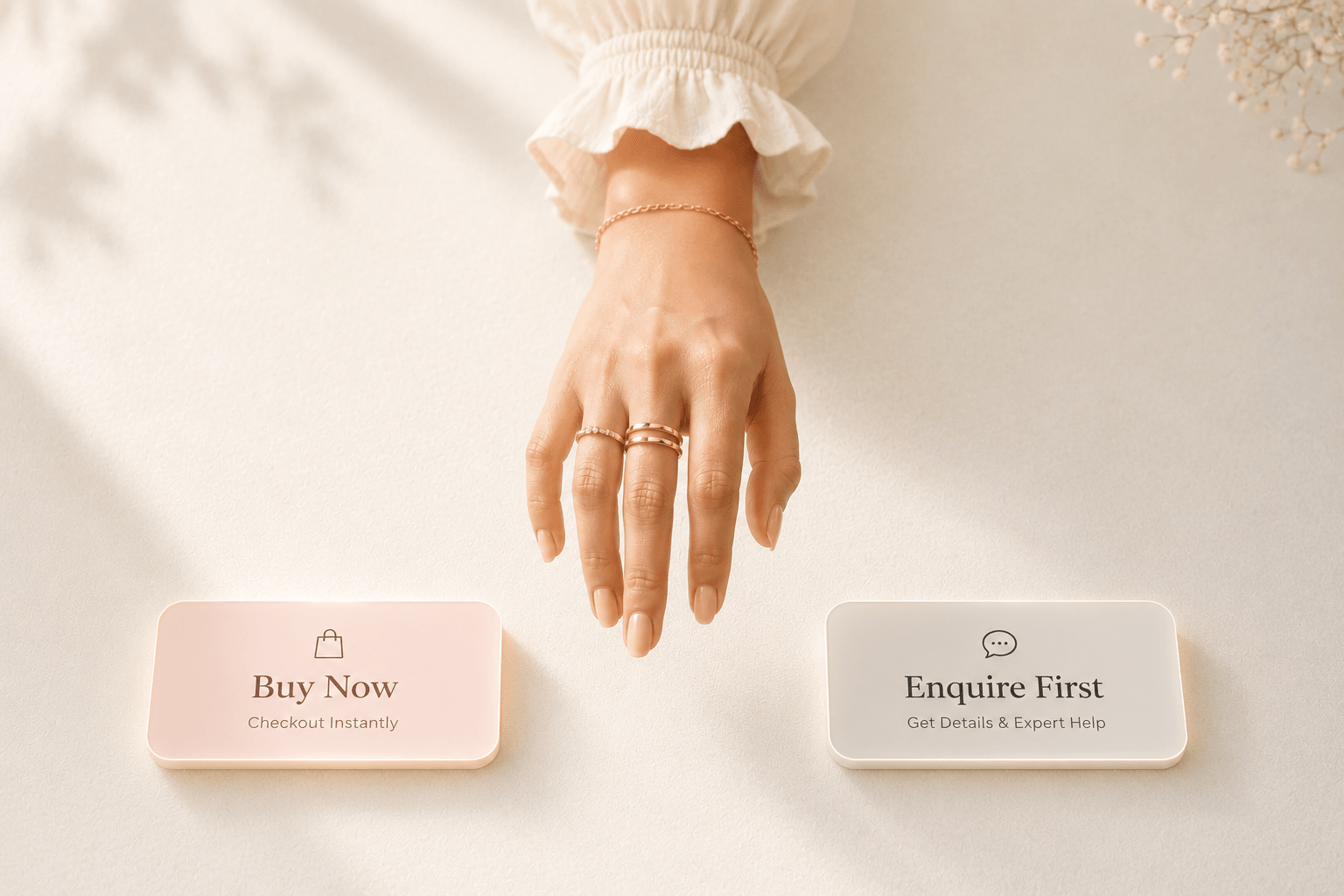
Let people buy the simple things directly. Let them enquire on the serious ones. The piece decides the path, not a blanket rule for the whole store.
The trick is doing this without the site feeling split down the middle, like two different websites stitched together. It should feel like one coherent brand where the buying action simply matches the piece: a clean checkout on a daily-wear ring, a considered enquiry flow on a bridal set. That’s a design and build decision, and it’s very doable, but it needs to be planned from the start rather than patched on later.
The mistake that costs you either way
The real error isn’t choosing enquiry or choosing e-commerce. It’s forcing one model onto everything.
A pure cart on a ₹5 lakh piece
The serious buyer wanted a conversation and got a “buy now” button, so they left.
A pure enquiry form on a ₹15,000 piece
The ready buyer wanted to pay and got made to wait, so you lost an easy sale.
Both mistakes are invisible in your reports. You just see people leaving, and never know why. The fix is to stop thinking about the store as one model and start thinking about it piece by piece. Match the buying action to how that piece actually gets bought.
Enquiry vs e-commerce, side by side
| Enquiry-based | Full e-commerce | |
|---|---|---|
| Best for | High-value, considered, bridal, studded, custom | Lighter, repeatable, fixed-design, lower-ticket |
| Buyer mindset | Wants a conversation before committing | Ready to decide and pay now |
| Risk if forced | Loses easy sales on affordable pieces | Loses trust on high-value pieces |
| Optimises for | Trust and relationship | Speed and convenience |
| For most houses | Use it for the serious pieces | Use it for the everyday pieces |
How to decide for your business
If you’re weighing it up, answer these four questions honestly. They’ll point you to the right model faster than any general advice.
What’s the price range of your pieces?
Mostly high-value and considered? Lean enquiry. Mostly affordable and repeatable? Lean e-commerce. A real spread? You likely need both.
Do your buyers usually want to talk before buying?
If most of your sales involve a conversation, questions, or a store visit, an enquiry flow matches how they already behave. If they mostly decide on their own, a cart fits better.
How much of your range is fixed vs one-of-a-kind or custom?
Fixed, repeatable designs suit direct checkout. One-of-a-kind and made-to-order pieces usually need an enquiry or a proper configuration flow.
Are you serving NRI or overseas buyers?
Cross-border, high-value buyers almost always want clarity and contact before ordering from abroad, which leans enquiry, or a very trust-heavy checkout, not a bare cart.
If your answers pull in different directions across your range, that’s not a problem. It’s the clearest sign you need a site that does both, built to handle each piece the right way. (Whichever way you lean, it helps to know what a build like that costs before you start.)
Frequently asked questions
Should jewellery be sold with a cart or an enquiry form?
It depends on the piece. Lighter, repeatable, lower-ticket jewellery suits a cart and direct checkout. High-value, considered pieces like bridal and solitaires often convert better through an enquiry flow, because buyers want a conversation before spending large amounts. Many jewellers need both.
Can one website have both e-commerce and enquiry?
Yes, and for most serious houses that’s the best answer. The key is building it so the buying action matches the piece: a clean checkout on everyday pieces, an enquiry flow on high-value ones, without the site feeling like two stitched-together sites. It needs to be planned from the start.
Is it worth having e-commerce if my pieces are expensive?
Often the stronger option for high-value pieces is a well-built enquiry flow rather than a hard checkout, because serious buyers usually want contact before committing. If you also sell affordable pieces, e-commerce makes sense for those. Match the model to the piece.
Do NRI buyers prefer enquiry or e-commerce?
NRI and overseas buyers buying high-value jewellery generally want clarity and reassurance before ordering from abroad (how it ships, duties, safety), so they lean toward an enquiry flow or a very trust-heavy, transparent checkout rather than a bare cart.
Which is cheaper to build, enquiry or e-commerce?
An enquiry flow is usually simpler than a full transactional checkout, but the cost difference depends on the overall build. The bigger cost drivers in jewellery are live pricing, variants, and inventory sync, not just which buying action you use.